
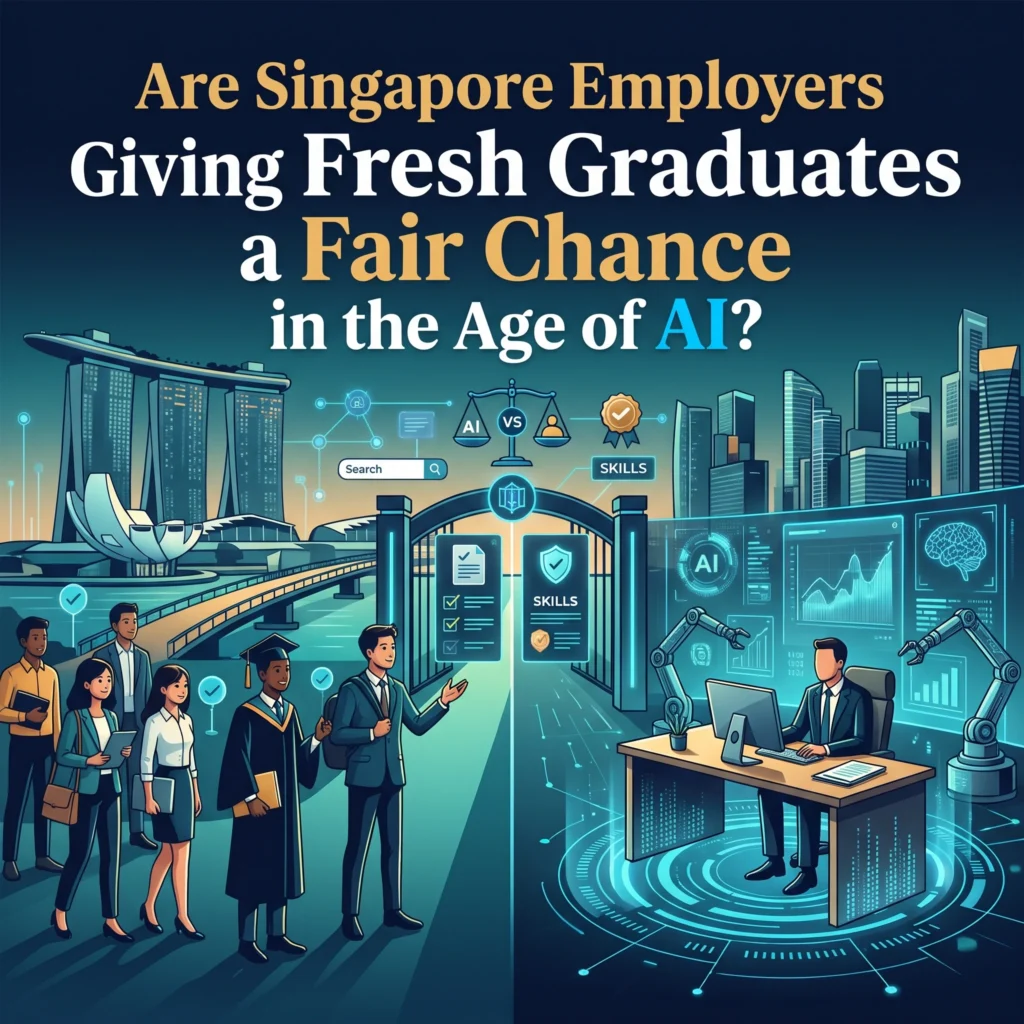
Are Singapore Employers Giving Fresh Graduates a Fair Chance in the Age of AI?
Graduate Employability | AI and Recruitment | Employment Contracts | Singapore Workforce Development
By Strategic Search Specialist (S) Pte Ltd (SSS)
The Changing Reality of Graduate Employment
For generations, the traditional pathway into professional employment has been relatively straightforward: complete formal education, secure an entry-level position, acquire practical experience and gradually progress into more senior responsibilities.
However, artificial intelligence (AI) is changing this pathway.
In his opinion article, “Gain work experience only after graduation? It may be too late”, published in The Straits Times on 29 October 2026, Terence Ho raises an important question about the future of graduate employment.
If AI can increasingly perform the routine tasks traditionally assigned to junior employees, how will fresh graduates acquire the foundational skills, professional judgement and practical experience needed to become tomorrow’s leaders?
This is not merely a concern for graduates. It presents a strategic workforce challenge for Singapore employers.
At Strategic Search Specialist (SSS), we believe graduate employability must be viewed as a shared responsibility involving educational institutions, employers, HR professionals and individuals entering the workforce.
1. AI Is Transforming Entry-Level Employment
Traditionally, junior employees develop workplace capabilities through tasks such as:
- Preparing reports, presentations and business correspondence.
- Conducting research and analysing information.
- Supporting administrative and operational processes.
- Assisting senior colleagues with projects.
- Learning through observation, feedback and practical assignments.
Today, many of these activities can be completed more efficiently with AI-enabled tools.
While AI offers significant productivity benefits, employers should consider the longer-term implications of reducing entry-level opportunities.
If organisations eliminate too many junior positions, they may inadvertently weaken their future leadership and specialist talent pipelines.
The challenge is not simply how to replace routine work with AI, but how to redesign entry-level work so that graduates continue developing valuable professional capabilities.
2. Should Workplace Experience Begin Before Graduation?
Workplace exposure should no longer be treated as something that begins only after formal education.
Internships, industry projects, structured attachments and practical assignments can help students develop:
- Communication and interpersonal skills.
- Problem-solving and critical thinking.
- Professional accountability and workplace discipline.
- Adaptability and resilience.
- Collaboration across different teams and cultures.
- Practical understanding of industry expectations.
However, the quality of workplace exposure matters.
An internship that consists mainly of repetitive administrative work may offer limited developmental value.
Employers should therefore consider designing structured internship programmes with clearly defined learning objectives, appropriate supervision, meaningful assignments and regular feedback.
For students, early exposure also provides an opportunity to assess whether their chosen career pathway aligns with their interests and capabilities.
3. Employers Must Rethink Their Graduate Hiring Strategies
A common recruitment challenge arises when employers advertise entry-level positions but simultaneously require candidates to possess substantial prior working experience.
This creates an obvious contradiction.
How can graduates gain experience if employers are unwilling to provide opportunities to acquire it?
Employers should distinguish between competencies genuinely required on the first day of employment and capabilities that can reasonably be developed through training.
A more sustainable approach involves:
Skills-based recruitment: Assess candidates on relevant competencies, learning potential, adaptability and problem-solving ability rather than relying exclusively on previous employment experience.
Structured onboarding: Provide clear job expectations, supervision and practical learning opportunities during the initial months of employment.
Mentoring and coaching: Encourage experienced employees to transfer professional knowledge, organisational understanding and judgement to younger colleagues.
AI-enabled job redesign: Allow junior employees to use AI responsibly while retaining opportunities to analyse, verify, communicate and make decisions.
Career development pathways: Establish realistic progression opportunities that encourage employees to build long-term careers.
Employers who invest in developing younger talent may strengthen workforce continuity and reduce future recruitment difficulties.
4. Employment Contracts Matter — Especially for Fresh Graduates
Graduate employability is not only about obtaining a job offer.
It is equally important that young employees understand the terms and conditions governing their employment.
Before accepting an offer, fresh graduates should carefully review:
- Job title and responsibilities: Are the actual duties clearly explained and consistent with the advertised position?
- Salary and remuneration: Are basic salary, variable payments, incentives and applicable allowances properly stated?
- Working hours and rest days: Are expectations clear and consistent with applicable employment requirements?
- Probation: What are the assessment criteria, probation arrangements and applicable notice periods?
- Leave and statutory entitlements: Are contractual provisions consistent with applicable Singapore employment legislation?
- Termination and notice: What obligations apply if either party ends the employment relationship?
- Training and development: Are any promised training arrangements or development commitments clearly documented?
In Singapore, employers must comply with applicable requirements under the Employment Act, including the provision of written Key Employment Terms to employees covered by the relevant statutory requirements.
Employers should also ensure their recruitment and employment practices align with applicable fair employment principles and legal obligations.
A properly prepared employment contract protects both employer and employee by establishing clear expectations from the beginning.
An employment contract should not merely document a salary and job title. It should provide clarity, accountability and a sound foundation for the employment relationship.
5. HR Professionals Have a Critical Role in Developing Future Talent
As AI transforms workforce structures, HR professionals must look beyond immediate recruitment needs.
Important questions include:
- Which junior roles are most exposed to AI-driven task automation?
- How can these roles be redesigned to provide meaningful learning?
- What competencies will employees need over the next three to five years?
- Are recruitment criteria unnecessarily excluding capable fresh graduates?
- Do employment contracts and job descriptions accurately reflect changing responsibilities?
- Are managers equipped to coach and develop inexperienced employees?
These questions require workforce planning, job analysis, recruitment expertise and sound employment practices.
Organisations that focus exclusively on short-term manpower cost reductions may overlook the long-term consequences of an insufficiently developed talent pipeline.
6. What Should Fresh Graduates Do Differently?
Fresh graduates must also take ownership of their career development.
Academic qualifications remain important, but employers increasingly value evidence of practical capability.
Students and graduates should consider building a portfolio of relevant experience through internships, project work, industry collaborations and other legitimate opportunities.
They should also develop AI literacy without becoming overly dependent on automated tools.
The ability to question information, evaluate AI-generated outputs, exercise judgement and communicate effectively will remain important across many professions.
When attending interviews, candidates should be prepared to explain not only what they have studied but also how they have applied their knowledge to solve practical problems.
Importantly, graduates should assess prospective employers carefully.
A job offering a slightly higher starting salary may not necessarily provide better long-term career development than one offering structured training, meaningful responsibilities and effective mentorship.
7. The Future of Recruitment Requires Shared Responsibility
Singapore’s future workforce competitiveness will depend not only on the adoption of new technologies but also on the development of human capabilities.
Educational institutions can strengthen industry exposure.
Employers can redesign entry-level roles and invest in training.
HR professionals can promote fair, competency-based recruitment and effective workforce planning.
Graduates can develop practical skills, professional confidence and adaptability before entering full-time employment.
AI should become a tool that enhances human potential, rather than an unintended barrier preventing the next generation from acquiring essential workplace experience.
The central question for employers is therefore:
If we stop hiring and developing inexperienced employees today, where will our experienced professionals and future leaders come from tomorrow?
How Strategic Search Specialist (SSS) Can Support Employers
Strategic Search Specialist (S) Pte Ltd is a Singapore Ministry of Manpower-licensed employment agency supporting organisations in identifying and recruiting suitable professional talent.
Our services include:
- Professional and executive recruitment.
- Recruitment needs assessment and candidate matching.
- Job description and role requirement reviews.
- Talent sourcing aligned with organisational workforce needs.
- Recruitment advisory for businesses building or restructuring their teams.
For broader employment contract, HR policy and workforce compliance requirements, employers may also engage Human Capital Consulting & Services (Singapore) Pte Ltd (HCCS), our separately operated HR advisory business.
Are you an employer reviewing your graduate recruitment strategy, redesigning entry-level roles or seeking professional talent in Singapore?
Contact us to discuss your workforce requirements.
Strategic Search Specialist (S) Pte Ltd (SSS)
MOM Employment Agency Licence No.: 23S2050
WhatsApp: +65 9436 2866
Building stronger talent pipelines through responsible recruitment and practical workforce planning.
Reference and Attribution
Terence Ho, “Gain work experience only after graduation? It may be too late”, The Straits Times, 29 October 2026 (print edition).
This article is an independent commentary prepared by Strategic Search Specialist (S) Pte Ltd. It draws on the broader workforce issues raised in The Straits Times opinion piece and is not a reproduction or endorsement by the newspaper.
Disclaimer: This article provides general recruitment and employment information and does not constitute legal advice. Employment requirements should be assessed against the applicable Singapore legislation and individual circumstances.